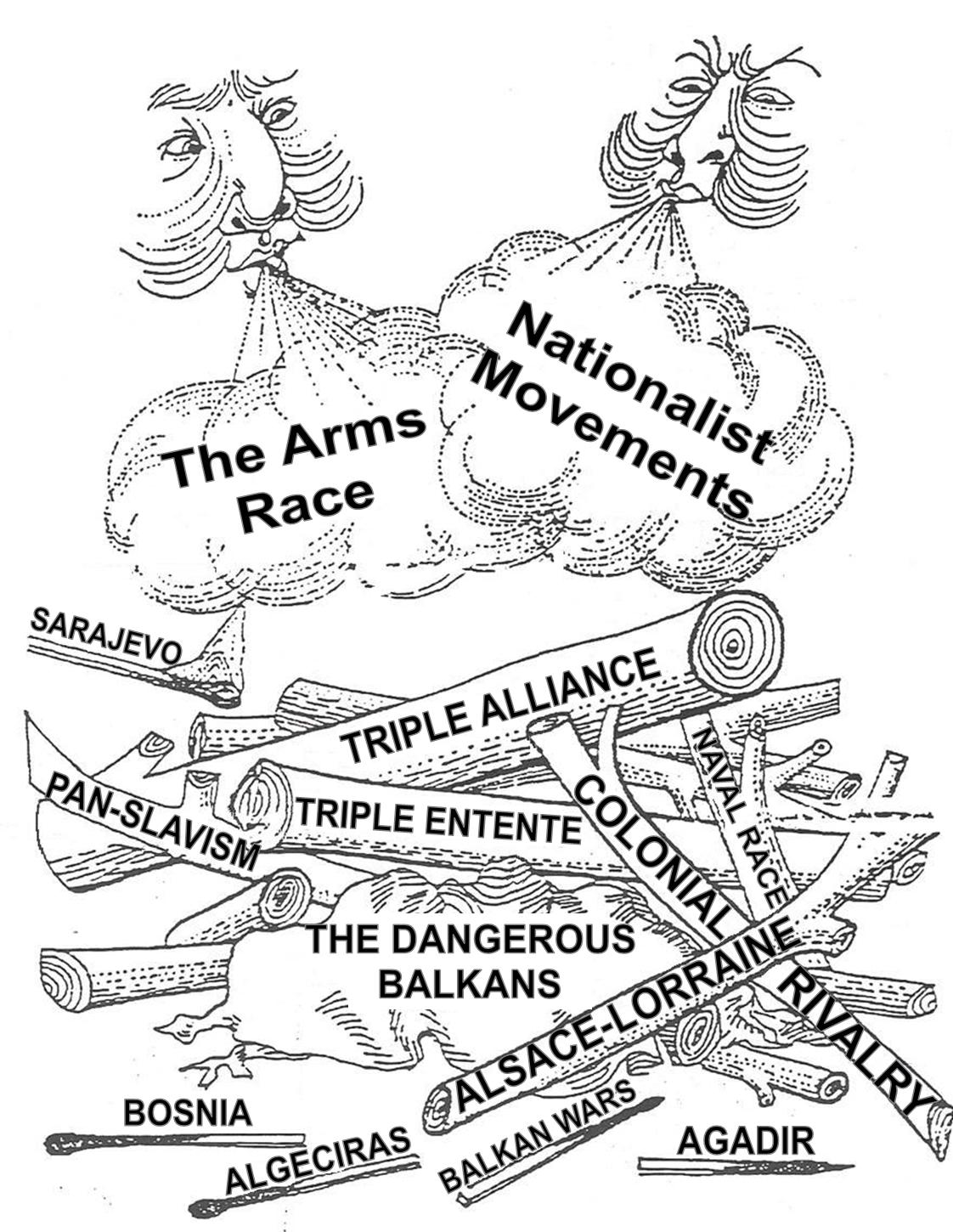
 es of World War I have been identified as Nationalism, Militarism, the Assassination of Franz Ferdinand, and the collapse if the alliance system.
Nationalism, as we know, is extreme loyalty to ones nation and concern for its welfare. After Napoleon’s exile, the Congress of Vienna in 1815, delegates from various European countries came together make peace. The principle of nationalism was ignored, leaving Germany and Italy as divided states. Also, large areas of Austria-Hungary and Serbia had many nationalist groups that all wanted independence from the states they lived in and were willing to fight for it.
Militarism is a nation’s policy to maintain armed forced, and in the beginning of the 2oth century and an arms race had begun. European countries began building large armies and navies. Germany had the largest military buildup, and Great Britain was following, with its own military buildup. Britain presented the “Dreadnought”, an advanced battleship, and Germany then followed suit, with their own battleships. Germany also made pre-war battle plans to attack France through Belgium if Russia attacked Germany. The thought of secret battle plans only caused anger and fear in other nations.
Another cause could be recognized as the collapse of the alliances. The Bismarckian diplomacy made two opposing alliances after the Franco-Prussian War. Bismarck formed the Three Emperor’s League in 1872, which was an alliance between Germany, Russia, and Austria-Hungary, to isolate France. The n Bismarck took advantage of Italy’s bitterness towards France while France occupied Tunisia and created the Triple Alliance between Germany, and Italy, and Austria-Hungary in 1882. This alliance meant that Germany and Austria-Hungary would protect Italy from France if war broke out between Austria-Hungary and Russia. In time, Austria-Hungary and Russia grew suspicious of each other over conflicts in the Balkans, so Bismarck fixed the damage to his alliances with the Reinsurance Treaty with Russia. This permitted both powers to stay neutral of the other was at war. However, due to so many different powers involved in mutual defense agreements, when the war began, it involved nearly ever country. Secret alliances also led to suspicion and the belief that other secret agreements existed.
n Bismarck took advantage of Italy’s bitterness towards France while France occupied Tunisia and created the Triple Alliance between Germany, and Italy, and Austria-Hungary in 1882. This alliance meant that Germany and Austria-Hungary would protect Italy from France if war broke out between Austria-Hungary and Russia. In time, Austria-Hungary and Russia grew suspicious of each other over conflicts in the Balkans, so Bismarck fixed the damage to his alliances with the Reinsurance Treaty with Russia. This permitted both powers to stay neutral of the other was at war. However, due to so many different powers involved in mutual defense agreements, when the war began, it involved nearly ever country. Secret alliances also led to suspicion and the belief that other secret agreements existed.The assassination of Archduke Franz Ferdinand is known as the immediate cause of WWI. On June 28, 1914, the Archduke and his wife were shot to death by Serbian nationalist of the Black Hand, Gavrilo Princip. The Archduke was shot because he wanted to turn Austria-Hungary’s monarchy into a triple monarchy and planned to include Serbia. Serbia wanted to take over Bosnia and Herzegovina. This assassination led to Austria Hungary declaring war on Serbia. Russia, who had an alliance to Serbia, began to mobilize, which made Germany declare war on Russia if the Russians didn’t demobilize. France acted in its own interests and mobilized, which made Germany declare war on France. Germany’s invasion of Belgium to attack France violated Belgium’s official neutrality, and led to Britain declaring war on France. Thus began the Great War.


No comments:
Post a Comment