Friday, January 11, 2008

Joseph Stalin and Totalitarianism

After Vladimir Lenin’s death in 1924, the two major contestants of political power were Joseph Stalin and Leon Trotsky. Trotsky was a gifted orator and a dedicated communist. Stalin was a talented organizer. Although Trotsky was a popular choice for the job of leader as the head of the new communist state, Stalin was also the party’s General Secretary. This job held a lot of power because Stalin appointed regional and local party posts in the government which allowed him to appoint those who would support his bid forever. By setting his minions deep into the political ladder, Stalin eventually became the official dictator of the Soviet Union.

Totalitarianism is the operating of a centralized government system in which a single party without opposition rules over political, economic, social, and cultural life. Basically, its dictatorship or tyranny. In the case of Stalin, he was totalitarianism. He controlled all details of public and private life. He made all the decisions. Stalin made the “Five Year Plans”. The goal of this plan was to transform the Soviet Union from an agricultural state to an industrial one within five years. This plan emphasized maximum production of capital goods. It succeeded in quadrupling the production of heavy machinery, doubled oil production, increased steel production and hard copal output. The cost of this, socially and politically, was quite heavy. Due to industrialization, many families lived pitiful lives, wages declined; there was child labor and strict laws limited workers’ freedom of movement. Also, since they were industrializing, the goal was to stop private farming and introduce collective farms. Farmers who resisted this program only led Stalin to be stricter with his policies. Many people died due to starvation because of the hoarding of food and slaughter of livestock.

The “Great Purge” was basically another Reign of Terror. Stalin killed anyone who opposed him. He became paranoid and killed important members of his party, people he once called supporters. Most of the people shot were colleagues of Lenin, original members of the party. Stalin’s dictatorship held great control over the general population of the country. Propaganda campaigns were made to indoctrinate the country with Communist thoughts and Stalin wanted to convert everyone into “Soviets”. He wanted everyone alike, to the point where he converted all languages into Cyrillic alphabet. Stalin had “secret police” known as the NKVD hunt down anyone who he suspected of “counter-revolutionary crimes. Stalin died of a stroke at age 73 on March 5th, 1953.

Thursday, January 10, 2008

The film “Dr. Zhivago” was very powerful in its depiction of the Russian Revolution. Russian’s wanted change. They didn’t like the unfair rulings of czars. Widespread inflation and food shortages in Russia contributed largely into the Revolution. In the beginning of the film, you saw an important event in the Russian Revolution known as “Bloody Sunday”. “Bloody Sunday” happened on January 22, 1905, when peaceful demonstrators who were marching to present a petition to the czar, Nicholas II, were gunned down by the Imperial Guard. “Bloody Sunday” and the development of revolutionary ideas and movements led to the Russian Revolution. Going more into the film, you saw that the Russian’s began to leave their stations on the Eastern Front and return back home. They saw no point in fighting a losing battle. When Doctor Yuri Zhivago, also a poet, went back home to Moscow, he saw the dramatic changes. His home used to be his own, but after the Russian Revolution and the following of communism, seven families shared his home with him, and his personal belongings were taken away from him. Communism is a classless society in which capitalism is overthrown by a working class revolution that gives ownership control of wealth and property to the government. That basically means that everything was owned by the government and no matter how hard or little you worked, everyone made the same amount of income. Everything was “fair”, in a sense. Dr. Zhivago was surprised to see so many people in his home. Due to communism, many people starved or froze to death. Dr. Zhivago had to go out and pull wood out of a fence to keep his family warm. That was against the belief of communism.


Friday, January 4, 2008

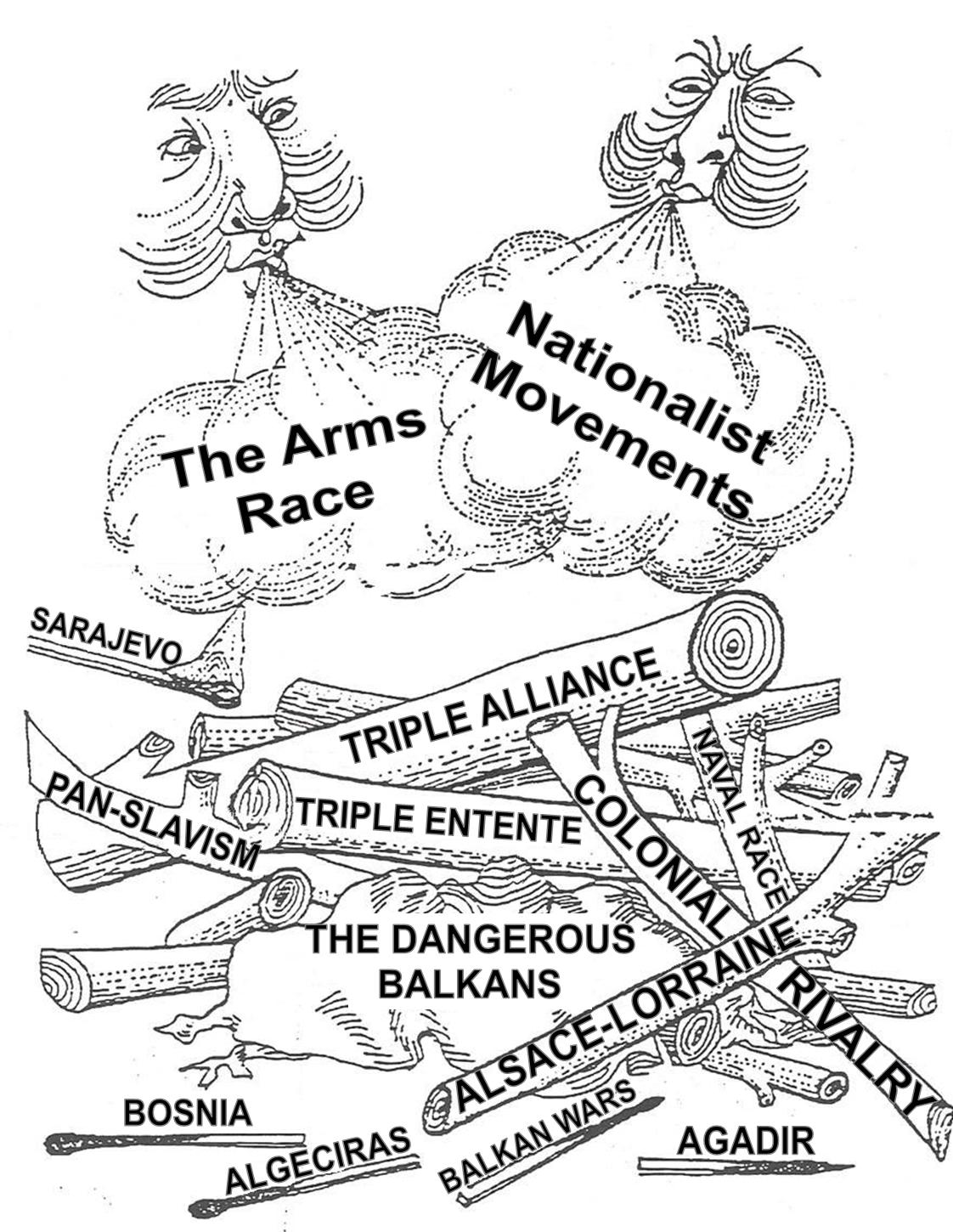
Causes of WW I

World War I, known as the Great War at that time was very complicated. The actual origin of the war was very deep. It had been building up, tensions of Europeans states increasing, until finally a chain of events led to the outbreak of fighting. The primary causes of World War I have been identified as Nationalism, Militarism, the Assassination of Franz Ferdinand, and the collapse if the alliance system.

Nationalism, as we know, is extreme loyalty to ones nation and concern for its welfare. After Napoleon’s exile, the Congress of Vienna in 1815, delegates from various European countries came together make peace. The principle of nationalism was ignored, leaving Germany and Italy as divided states. Also, large areas of Austria-Hungary and Serbia had many nationalist groups that all wanted independence from the states they lived in and were willing to fight for it.
Militarism is a nation’s policy to maintain armed forced, and in the beginning of the 2oth century and an arms race had begun. European countries began building large armies and navies. Germany had the largest military buildup, and Great Britain was following, with its own military buildup. Britain presented the “Dreadnought”, an advanced battleship, and Germany then followed suit, with their own battleships. Germany also made pre-war battle plans to attack France through Belgium if Russia attacked Germany. The thought of secret battle plans only caused anger and fear in other nations.
Another cause could be recognized as the collapse of the alliances. The Bismarckian diplomacy made two opposing alliances after the Franco-Prussian War. Bismarck formed the Three Emperor’s League in 1872, which was an alliance between Germany, Russia, and Austria-Hungary, to isolate France. Then Bismarck took advantage of Italy’s bitterness towards France while France occupied Tunisia and created the Triple Alliance between Germany, and Italy, and Austria-Hungary in 1882. This alliance meant that Germany and Austria-Hungary would protect Italy from France if war broke out between Austria-Hungary and Russia. In time, Austria-Hungary and Russia grew suspicious of each other over conflicts in the Balkans, so Bismarck fixed the damage to his alliances with the Reinsurance Treaty with Russia. This permitted both powers to stay neutral of the other was at war. However, due to so many different powers involved in mutual defense agreements, when the war began, it involved nearly ever country. Secret alliances also led to suspicion and the belief that other secret agreements existed.
The assassination of Archduke Franz Ferdinand is known as the immediate cause of WWI. On June 28, 1914, the Archduke and his wife were shot to death by Serbian nationalist of the Black Hand, Gavrilo Princip. The Archduke was shot because he wanted to turn Austria-Hungary’s monarchy into a triple monarchy and planned to include Serbia. Serbia wanted to take over Bosnia and Herzegovina. This assassination led to Austria Hungary declaring war on Serbia. Russia, who had an alliance to Serbia, began to mobilize, which made Germany declare war on Russia if the Russians didn’t demobilize. France acted in its own interests and mobilized, which made Germany declare war on France. Germany’s invasion of Belgium to attack France violated Belgium’s official neutrality, and led to Britain declaring war on France. Thus began the Great War.