Friday, September 28, 2007

Robespierre and The Reign of Terror

Although the French Revolution was an eminent event, during the course of it, a lot of blood was shed. Since much of Louis XVI’s power was taken away from him, he ruled in limited monarchy. A Legislative Assembly was set up to help the King with his decisions and share his power. Louis XVI didn’t like that he didn’t have absolute power so he tried to run away, but was unsuccessful. France was confused with everything and couldn't’t figure out who controlled the country. Street gangs were formed that killed anyone that didn’t agree with their plans, still believing in the ways of the old Regime, and sometimes, they had even more power than the government. One such group was the Jacobin, and this was the group that actually took it as far as to execute King Louis XVI with the use of the guillotine. To help with domestic crisis, the National Convention to the Committee of Public Safety (Comite de Salut Public) elected Maximilien Francois Marie Isidore de Robespierre to be the leader of it. Robespierre was the mastermind behind the Reign of Terror. He was known as the most powerful man in France.
Robespierre had control of everyone and everything. The Reign of Terror began September 5, 1793. The first person executed was Marie-Antoinette. If anyone went against him, he had them executed by the popular guillotine. You could have been anyone, his friend or relative, and the next day you would’ve been executed. He wanted anyone that believed in the Old Regime gone. The calendar was changed and months re-named because religion was old-fashioned. Robespierre once said that “Softness to traitors will destroy us all”. The reign of terror basically happened to have full control and prevent counter-revolutions from gaining way. It is said that in a single month before the reign of Terror ended, 1, 900 executions took place. It still isn’t known exactly how many lives were taken during the course of this event. Some people believe that about 40,000 to 50,000 executions took place, but no one knows for sure.
Robespierre seemed to threaten other members of the Committee of public Safety when he tried to call a new purge. Not only that, but several people were tired of all the many executions, and many members of important committee’s thought they were next in line. The Jacobin's had enough and a conspiracy was formed. Robespierre and 19 of his followers were arrested and sent to the guillotine. That was the last execution of the Reign of Terror.

Thursday, September 27, 2007

The French Revolution: Social Causes

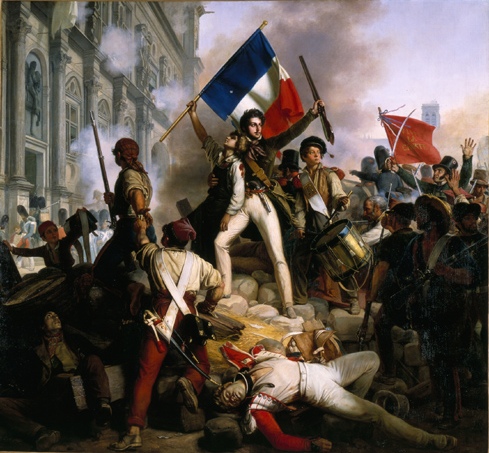
On the morning of July 14, 1789, a mass of about 80,000 Parisians in search of weapons, marched toward the Bastille, which was a royal arsenal filled with weaponry and ammunition. This was when the French Revolution began. The French Revolution was a major event in history. France was transformed from a monarchy with feudal privileges for the aristocratic and Catholic clergy, to a republic with equally free citizens, based on Enlightenment principles of life, liberty, and property. Its effects were widespread inside and outside of France. Of course this couldn't’t be done easily, Blood was spread, and heads were chopped off, not-to-mention, the effect of Napoleonic wars, but all for a good cause.

King Louis XV ruled and he was a great king and ruled under great control. But then he passed away, and Louis XVI took his place. He was a complete bad choice for the job. He ruled poorly, was very lazy, and also his wife, Marie Antoinette, splurged on an everyday basis. At that time, France ran under the Old Regime. French society was broken up into three estates. There was the First Estate, which consisted mainly of the Catholic Church and its clergy, the Second Estate was the nobility, who was the rich and aristocratic, and then there was the third Estate, while all the commoners and everyone else. The First Estate was excused from taxes, only having to pay a “voluntary” contribution every five years. They made up only one percent of the population. The Second estate also had tax exemptions, and while they held 30% of the land, they only made up of about 2% of the population. The Third Estate basically paid all the taxes. They made up more of the population than any other estate and yet they had no say in the government.

The first thing to actually “trigger” the French Revolution was the storming of the Bastille. After three hours of commoners fighting, the garrison of about 115 men gave up. The commoners in rage, beat marquis de Launay to death, cut of his head, and then carried him around the city with pride. When King Louis XVI heard of this, he asked, “Why, is this a revolt?” The duke who told him replied, “No sire, it is a revolution.” After that, the Reign of Terror began, which was when the French Revolution really got bloody with a stream of executions by the guillotine. This lasted about 10 months. During this time, it is said that about18, 500 to 40,000 people were executed.

At the end, a stream of women came pouring into Versailles, where King Louis XVI lived, carrying a varied assortment of house materials such as brooms, pitchforks, and etc, and took both King Louis XVI and his wife Marie Antoinette, away They were made prisoner. Both him and his wife were executed by the guillotine.

Tuesday, September 11, 2007

Copernicus and the trial of Galileo

The scientific revolution can be dated as having begun in 1543, coincidentally, the year in which Nicolaus Copernicus published his book De revolutionibus orbium coelestium (On the Revolutions of the Heavenly Spheres. Although many early cosmologies contemplated the motion of the earth around an inert sun, it wasn't until Copernicus's book that people actually started to support it. His book introduced heliocentrism in a whole new way. Copernicus's book presented a fully predictive mathematical model of a heliocentric system, which was later elaborated by Johannes Kepler and defended by Galileo Galilei, becoming the center of a major religious dispute.

Before the scientific revolution, the geocentric model of the universe was accepted by everyone. The geocentric theory is that the earth is the center of the universe and the sun and all the other planets went around it. This theory was adopted by both Aristotle and Ptolemy.

Galileo Galilei was known as the man to pioneer the "experimental scientific method" and was also the first to use a refracting telescope to make important astronomical discoveries. Galileo, by learning the merest description of the telescope, built a bigger and better model. Using his telescope, Galileo made significant discoveries about space, the planets and their moons. Galileo was a professor of astronomy in the University of Pisa, he was required to teach the theory of geocentrism. But later, in the University of Padua, he learnt of a new theory, Copernicus's theory. Galileo used his telescope and observed that that theory was the correct one. His support for this theory got him in trouble with the roman Catholic Church.

The Roman Catholic Church were very powerful during the 17th century and they still believe that the sun revolved around the earth. Galileo, spreading peoples awareness of heliocentrism aggravated them. The Roman Catholic church called him to Rome for trial. Inquisition convicted him of heresy and forced him to publicly withdraw his support to Copernicus's theory. He was also sentenced to life imprisonment, but due to his old age he was allowed to serve his time as house arrest in his villa in Arcetri. Galileo died at Arcetri in 1642. In 1992, the Roman Catholic Church admitted to having been wrong in dealing with Galileo.

Monday, September 10, 2007

Scientific Revolution: Scientific Method

Before the 1500's, scholars and academics would look toward the bible and ancient Greek and Rome for answers and ideas about science. The scientific revolution was when medieval scientific philosophy was abandoned for new methods of science. Scientists such as Bacon, Galileo, and Newton proposed a new ways to answer ideas. It was called the scientific method. The scientific method was a process of research where a problem is identified, data is collected, a hypothesis is made from the data, and than the hypothesis is tested repeatedly until a conclusion is made. This change was important because it allowed scientists to work with mathematicians and astronomers to get better, more reliable results.

The scientific method is made up of a few very simple steps. Firstly, you have to of course, create a question or problem you wish to be answered. Secondly, you do research on your topic so you can predict an answer for your question. Thirdly, you form an hypothesis, or an educated guess of what you think the answer to the question is. Remember that it doesn't matter if your hypothesis is wrong or right. After that, you have to conduct an experiment for your question. It would be best to repeatedly test your question for best results. Than, you have to collect all the data. Finally, you form an conclusion based on all you did.

An example of the scientific method can be when Galileo, a young Italian, proved Aristotle's theory wrong in the late 1500's. Aristotle's theory was that heavier objects fell faster than light objects. Galileo tested the theory by going up to the famous Leaning tower of Pisa and he dropped some stones of different sizes and weights. His experiment proved Aristotle wrong and lead us to what we know now, objects of different weights will fall at the same speed.

Thursday, September 6, 2007

Evolution vs. Creation

Evolution vs. creation. Also, popularly known as the reason vs. religion battle that has been going on for ages. There has been evidence to support both but no proof. People just believe what they choose to believe in.

Evolution is the theory that all organism's have an common ancestor. Darwin's theory was that random mutations would occur within a organism's genetic code, which is called crossing over. The advantageous mutations would be kept because they aid in survival. Then these organisms that are best adapted in their environment reproduce and pass on their traits to the nest generation. The less adapted organisms will eventually die. This process is known as survival of the fittest. Due to these mutations and competition, organisms with mutations would move to a new environment and learn to adapt there, making changes in its appearance. Then speciation will occur. Speciation is the splitting of one species into two due to separation by reproduction by some effect of a different trait. Then eventually, the organism will move again and so on and so forth.

Creationism is the believe that the earth, all the creatures in it, and the universe were created by god, or such a deity. Most creationists believe that the earth was created in seven days and was shaped by floods as stated in the book of Genesis, for Christians and Jews, and the Qur'an, for Muslims. The theory of creation says that creatures started out lucind and seperated creatures. But creationist do not believe that those creatures gradually change into completely different and seperated creatures during evolution. They do not believe that through time, single-celled organisms evolved into more complex plants and animals and eventually into Homo Sapiens. Creation is the belief that ever organism is created by someone whose existence is yet unknown to us. There are many different types of creationism. There is young earth creationism, old earth creationism, gap creationism, progressive creationism, intellignet design, and thiestic creationism.