Friday, December 14, 2007

The Opium Wars

Asia became an important area of international competition in the 19th century. For many years, China had remained isolated from the very world it was in. They believed that they were superior to everyone else. Sounds familiar? They were not impressed by the European culture. The Finally, China began to trade. The Chinese exported tea, a very trendy leaf, to Britain. Britain was left to only trade gold and silver with China since China was a self sufficient country.

Eventually, Britain began running out of gold and silver, and tried to trade any other product with them, whether it be new inventions or food, but the Chinese weren’t impressed and said no. Britain then did a very sneaky thing. They introduced the addicting narcotic opium to China. Opium was already sold in China, but not for the reasons the Britain wanted. In China, opium was a medicinal product, used for headaches and the such. The British introduced it as a drug, and the Chinese were addicted. Now, the British could trade something other than silver and gold with the Chinese.

Chinese naturally was a very populated country, and opium was killing off most of the population. About ten percent of China was addicted to opium, and China needed a more variety of products to trade with the British. Eventually, the Chinese emperor was sick of it. Opium was weakening them. He sent a letter and asked Britain to stop trading opium with them. The British refused and continued trading opium, even after laws were set up making it illegal to smoke opium.

War ultimately broke out. The Chinese were no match for the British. The Chinese only had old-style weapons and artillery which the British had gun ships and steamboats. The Chinese weren’t prepared for Britain’s technological superiority and faced a humiliating defeat. In 1842, they were forced to sign the Treaty of Nanking. This treaty let Britain use five of the Chinese ports instead of one, gave control of Hong Kong to Britain, and forced the Chinese to legalize opium.

Monday, December 10, 2007

"The White Man's Burden"

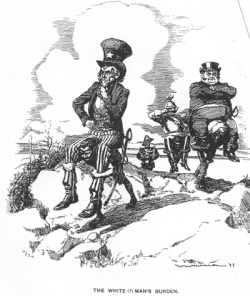
The concept of the “White Man’s Burden” is a belief that the superior race, the “white man”, is obligated to teach all other inferior races the practice of a higher level of organization. It is associated with imperialism. The poem “The White Man’s Burden” by Rudyard Kipling illustrates that belief. Imperialism was linked to social Darwinism, which was the belief that in the battle of nations, only the most fit will triumph and will survive. It was believed that the superior race was to dominate the inferior races by military force and show how strong they are. Europeans also took a religious point of view of this. They believed it was their Christian duty and moral responsibility to civilize these “ignorant” people. However this concept was believed, it would always be a manifestation of racism.
I don’t completely believe in this theory. In a sense, we should help other countries in their struggles to modernize. We should help them civilize, but if anything we should only counsel them on what to do. After they have gotten down how they want their government to be, we should guide them in their decision making. If we just start to try to change them and their own beliefs, their will be war, and that id proved by U.S. imperialism in the Philippines.
The U.S. is still imperialistic. That can be justified by our presence in Iraq. We still carry out the “White Man’s burden” today, thinking that it’s for the good, and it is, at times. We should help other countries out that are on the verge on self-destruction. But after we get the basis down, we should guide them in a slightly aggressive way to show those countries what is for the better, but still listen to what those countries beliefs are.

Wednesday, December 5, 2007

The Scramble for Africa

In the beginning of the 1880’s, European states engaged in a fierce competition for oversea territories. Many believed in social Darwinism, thinking that the superior races must dominate and civilize the inferior races to show how strong they are. One Englishman once wrote, “To the development of the White Man, the Black Man and the Yellow must ever remain inferior, and as the former raised itself higher and yet higher, so did these latter seem to shrink out of humanity and appear nearer and nearer to the brutes.”
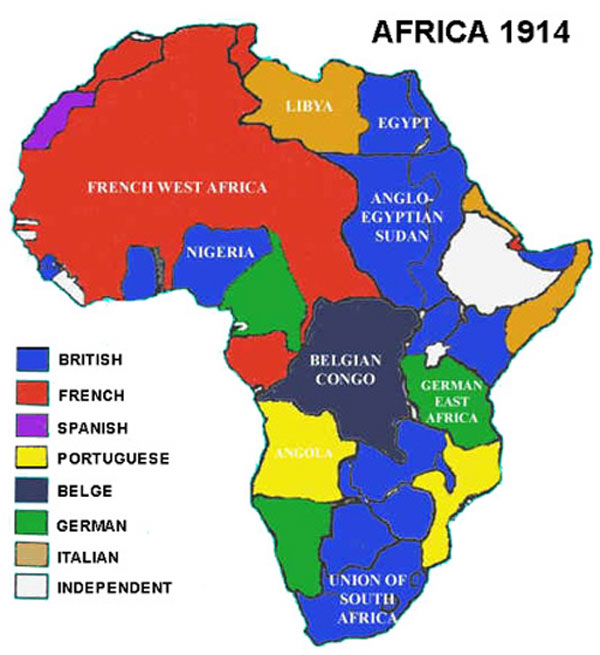
Before this time, the Europeans didn’t control much of Africa, having only been established in southern Africa. The “scramble for Africa” was a race against Britain, France, Germany, Spain, Italy, Belgium, and Portugal to control parts of Africa as their own. Each of these countries wanted Africa for their own reasons. For example, Britain wanted Africa so they could control the significant sea route to India, and France was interested in the slave trade. Most of the nations were looking for good, silver, and other valuable goods. Africa had an enriched amount of natural resources, and was known for its diamonds and ivory. Not to mention the slave trade.
The British policy in Africa was mainly controlled by Cecil Rhodes in the 1880’s. Rhodes had the control of many diamonds and gold mining companies. He was known as the great champion of British expansion and even named a country in Africa after himself. It was fairly easy to dominate Africa. The country wasn’t united, and they weren’t exactly modern in the sense of that time. The Europeans had many advantages. They had advanced weaponry, superb planning, and many great inventions such as the steam ship. The scramble largely affected the African people. They were being controlled by foreigners. Also, as said before, the country wasn’t united. Many of the tribes had grudges against each other, and when the Europeans took over, they made boundaries putting fighting tribes together. But the Europeans didn’t stop with just Africa, they had a “burden”, and with that burden came “responsibilities”.

Monday, December 3, 2007

Film Lesson" "Mountains of the Moon"

Europeans faced a lot of problems while in Africa. This can be seen in the film “Mountains of the Moon”. The two main characters, Sir Richard Burton and John Speke didn’t know what was in store for them on their journeys. It was a simple enough goal, to find the source of the Nile River. But hardships occurred along the way. Their first journey into Africa was a short one. The Africans had never seen white men before. With their unique appearances, the African tribes weren’t reluctant to attack them. Burton barely got away, having a javelin, or a spear, inserted through his cheeks. Speke was captured with a few other of their slaves, but he got away in the middle of being tortured. Then they return to England, failing in their expedition, but start again.
This time they are funded by the Royal Geographic Society and are fully equipped. Of course this helps, but there are still many hardships they go through. In the course of their second trip, they are attacked by tribes as well as bugs. A bug went into Speke’s ear and to take it out they had to drop candle wax into his ear, ruining his ears. Also, the slaves they hired weren’t trustworthy, many fled in the middle of the night with a lot of equipment. There were other hardships such as lions, depletion of food and water, and diseases. Somehow, when Burton was walking on rough terrain, his legs weakened and he couldn’t walk anymore. Last but not least, they were captured by a tribe and were held hostage until the tribe received goods. Burton and Speke gave the tribe some of the last of its possessions. Finally, at the end, Speke found the source of the Nile River, Lake Victoria.
Lake Victoria is a very odd name to give to a lake in Africa. If the lake was in Europe, it would be typical, but this lake was a in Africa. The Europeans immediately thought it theirs, thinking they were the first people to discover it and named it after their queen, when in reality, many Africans knew about the Lake. The Europeans had many advantages over the Africans. Firstly, they had a technological advantage over the Africans. The Europeans had advanced weaponry, superb planning skills, and plenty of inventions to help them, as to the Africans who had spears and knifes in the least. Also, the Europeans had a major advantage over the Africans due to no unity. Africa was set up with many different tribes that fought against each other, so it easy to defeat them.

Tuesday, November 27, 2007

The Meiji Restoration of Japan

Before the Meiji Restoration, Japan was basically ignorant of all the technological advances that had occurred. The Japanese thought themselves to be the most superior of all races. That was why they banned Christianity in 1597, butchering all who practiced that religion. The Japanese never let anyone into their country, believing they had nothing good to learn from the outsiders, and they stayed like that for 250 years. Over the years that they had their doors closed to everyone else, they had great peace and prosperity in their land, however the industrial revolution in the west would propel Europe and the United States to a level of advancement that the Japanese would never anticipate.

During the opium wars between Great Britain and China, there was a lot of naval traffic in the coastal waters of China, and countries became interested in Japan. The United States, especially, saw the potential in Japan. They saw it as a coal reloading station and they also looked at Japan as a necessary trading acquisition. When the Japanese realized what position they were in, they pushed it off seeing nothing that interested them and having no reason to meet the terms with foreign requests to open Japanese ports for trade. The Commodore Matthew Perry arrived on the Japanese shores of Edo (Tokyo) with four warships. They had come to open up Japan, in need of water and coal. The Japanese were in awe, calling them black ships with the billowing smoke from their engines. The message Perry sent was clear: to either open up your ports or well open them up for you. The Japanese knew full well they couldn’t defend themselves against the huge ships with its huge cannons, so they opened their ports.

When the Japanese saw the economic changes in the West, they felt they also needed to upgrade. They adapted concepts of western civilization into their country. They built railways and shipping lines, had telegraphing and telephone systems. They made factories to make consumer goods faster. They also created a national educational system and elected parliament called Diet. They sent many Japanese people to study abroad. The Japanese Archipelago forms Detailsthe country of Japan. It is a chain of islands. This archipelago consist of more than 3000 islands, including the four main island: Hokkaido, Honshu, Shikoku, and Kyushu.


Thursday, November 15, 2007

Karl Marx and Communism

Karl Marx was an economic and political philosopher. As we went over, Marx didn’t like the Industrial Revolution because of its treatment to workers. He detested capitalism, which is an economic system where a company was run privately and only operated for profit. He formed the counter for it, Communism. Communism was a form of socialism that eliminated private ownership, and favored a classless society.

Communism seems to be a great thing. In communism there would be no class system, which meant no bourgeoisie and proletariat. Bourgeoisie is the class filled with business owners and landlords and proletariat class was all the hard-working people. It meant that everyone would be treated the same, and paid the same. Everything was owned by the government, so no arguing or fighting would occur among the people. Marx thought this would be a distinguished government because everything would be shared, with peace eventually being brought.
Karl Marx created a club called the Communist League. In 1844, Marx met another German philosopher is Paris, Friedrich Engels. They became very good friends, and together they wrote the Communist Manifesto, which laid the foundation for socialism and communism. It was written the send messages to the proletariat class, telling them unite in a worldwide effort to overthrow capitalism and to get rid of the class system. He also wrote Das Kapital (The capital), which he is well-known for. It took him thirty years to complete and was published in three volumes.

Karl Marx and the Industrial Revolution

The Industrial Revolution was a time of great modernization and technological advances. It improved everyday life, making labor easier with new machines. Products were made faster and easier, for cheaper prices and in surplus. While most people thought the Industrial Revolution was an extraordinary thing, some people disagreed. One such person was Karl Marx. Karl Marx disliked the Industrial Revolution a lot.

Karl Marx is one of the most influential socialist thinkers that had emerged during the late 19th century. Karl Marx disliked the Industrial Revolution greatly. He was distressed by the treatment of factory workers in Europe. The conditions in factories were cruel and unsafe. Marx broke down the social classes into two categories: the bourgeoisie, being factory & business owners and landlords and the proletariat, everyone else. He thought that the proletariat class was forever to be doomed with work and will always be in the mercy of bourgeoisie, if they didn’t unite and overthrow the bourgeoisie class. Marx believed that workers as to landlords should control factories and farms. He thought that the workers in factories should be given all the power and wealth should be distributed equally amongst them. Marx’s ideas were known as Communism, a word formed from common. Communism is a system in which goods are owned in common and are available to all as needed. It is the abolition of oppression or the power of people over people.
Marx's ideas were known as Communism, a word formed for common. Workers would share wealth in a communist society. Marx wrote that wealth should be distributed "from each according to his abilities, to each according to his needs." Thought he was basically unobserved by most scholars, his political, economic and social ideas gained acceptance after his death.

Friday, October 19, 2007

Nationalism and the Creation of Italy

Nationalism had an enormous influence on world history. Nationalism is the love of your country, and your willingness to sacrifice for it. It is the loyalty and devotion you have for your country, to put your country above all else. Nationalism makes the basis of a country so much stronger. It can unite countries, as it did in Italy, or divide a country, like the Balkans during the 20th century. I am Nationalistic. How? I speak English; I know the National Anthem and Pledge of Allegiance by heart. I know quite a lot of U.S. history; I eat American food, listen to American music, and wear American styles. I know what’s going on in the news, and etc. I can say fairly, that I am proud of my country and am quite nationalistic.

During the 1800’s, the feelings of Nationalism erupted in many countries of Europe. France, during the regime of Napoleon, Germany, where unification was achieved, Russia, where modernization was occurring, the United States which underwent the Civil War, and Italy, where unification was also was achieved.

Italy was broken up into small provinces that were governed by foreign countries. Venetia and Lombardy were ruled by Austria, and the two Sicilies were ruled by Spain. The Italians eventually were fed up with other countries ruling them. Nationalistic feelings surfaced and Italians united, moving toward unification. Three great leaders rose to help; Guiseppe Mazzini, Count Camillo di Cavour, and Guiseppe Garibaldi. Mazzini started a group called Young Italy in 1831, which was a nationalistic movement that wanted to end foreign rule. Cavour was the prime minister of Sardinia, a large Italian state. He formed alliances with other powerful countries to end foreign rule. Garibaldi was a military leader who liberated most of Southern Italy with his Red Shirt army. In an election, Garibaldi was voted the right to be able to unite Southern Italy with the Kingdom of Piedmont-Sardinia. Lastly, in 1870, Italy took over the last Papal States and chose Victor Emmanuel as their King. As you can see, Nationalism had a great part in this movement.

Monday, October 15, 2007

Simon Bolivar and Latin American Revolutions

In the history of the Western Hemisphere, the Latin American revolutions is said to be one of the most influential series of events. Latin America, which included South America, Central America, and the Caribbean, was being conquered by foreigners. Spain had built an entire empire there to control the natural resources, and export them back to themselves. Remember that at this time, Napoleon’s brother, Joseph Bonaparte was installed by Napoleon was king of Spain. The people in Latin American heard about the Enlightenment thinkers, and how the French and Americans revolutionized, and they thought about their own situation. They also wanted to equality and liberty that the French and the Americans had fought for, so they all started revolutionizing. Simón Bolivar set independence for many countries in South America including Columbia, Venezuela, Peru, and Ecuador. He was known as “the Liberator”, and is a idol to many South Americans.
Simón José Antonio de la Santísima Trinidad Bolívar was born on July 24, 1783 in Caracas, Venezuela. He was born an aristocrat and received superb education. Thanks to his tutors, he learned of the Enlightenment and classical Greece and Rome. At the age of nine, his parents died and he was left in the care of his uncle and at the age of fifteen, he was sent to Spain to continue his education. In Spain, Bolívar met Maria Teresa Rodríguez del Toro y Alaysa and married her in 1802. Sadly, when they returned to Venezuela in 1803, she died of yellow fever. Bolívar was so deeply affected by her death; he vowed never to marry again. While he was in Europe, Bolívar saw the proclamation and coronation of Napoleon Bonaparte and, because Napoleon betrayed his republican ideas, lost all respect for him. However, it was while Bolívar was in Italy that he made his famous vow atop Mount Aventin to never rest until South America was free.
During that time, Napoleon had installed Joseph as King of Spain. Caracas declared its independence from Spain, and Bolívar was sent to Spain to deliver the message. Bolívar thought that New Granada should help free Venezuela, and that would help free New Granada, and he wrote exactly this to Cartagena Manifesto. Bolívar received the assistance he needed and invaded Venezuela. He was proclaimed the “the Liberator”. Bolívar captured Caracas on August 6th, and made it Venezuela’s republic.
Bolívar won many battles there after. It was during the Battle of Boyaca in August 7, 1819 that Bolívar had his greatest victory. That year, Bolívar created the Angostura Congress whom founded Gran Columbia. Gran Columbia was a alliance of Venezuela, Columbia, Panama, and Ecuador, and named Bolívar president. In 1823, Bolívar invaded Peru and with Sucre, defeated the Spanish army in Lima. Than in the Battle of Ayacucho, Sucre defeated the rest of the Spanish army. On August 6, 1825, Sucre called the Congress of Upper Peru and created the Republic of Bolivia, named after Bolívar. Bolívar personally wrote the Bolivian Constitution of 1826, which was never quite enacted.
Unfortunately, by 1827, due to the competition between the generals of the revolution, civil cars began everywhere which destroyed the unity of South America that Bolívar had fought got. El Libertador Simón Bolívar died on December 17, 1830 due to tuberculosis.


Friday, September 28, 2007

Robespierre and The Reign of Terror

Although the French Revolution was an eminent event, during the course of it, a lot of blood was shed. Since much of Louis XVI’s power was taken away from him, he ruled in limited monarchy. A Legislative Assembly was set up to help the King with his decisions and share his power. Louis XVI didn’t like that he didn’t have absolute power so he tried to run away, but was unsuccessful. France was confused with everything and couldn't’t figure out who controlled the country. Street gangs were formed that killed anyone that didn’t agree with their plans, still believing in the ways of the old Regime, and sometimes, they had even more power than the government. One such group was the Jacobin, and this was the group that actually took it as far as to execute King Louis XVI with the use of the guillotine. To help with domestic crisis, the National Convention to the Committee of Public Safety (Comite de Salut Public) elected Maximilien Francois Marie Isidore de Robespierre to be the leader of it. Robespierre was the mastermind behind the Reign of Terror. He was known as the most powerful man in France.
Robespierre had control of everyone and everything. The Reign of Terror began September 5, 1793. The first person executed was Marie-Antoinette. If anyone went against him, he had them executed by the popular guillotine. You could have been anyone, his friend or relative, and the next day you would’ve been executed. He wanted anyone that believed in the Old Regime gone. The calendar was changed and months re-named because religion was old-fashioned. Robespierre once said that “Softness to traitors will destroy us all”. The reign of terror basically happened to have full control and prevent counter-revolutions from gaining way. It is said that in a single month before the reign of Terror ended, 1, 900 executions took place. It still isn’t known exactly how many lives were taken during the course of this event. Some people believe that about 40,000 to 50,000 executions took place, but no one knows for sure.
Robespierre seemed to threaten other members of the Committee of public Safety when he tried to call a new purge. Not only that, but several people were tired of all the many executions, and many members of important committee’s thought they were next in line. The Jacobin's had enough and a conspiracy was formed. Robespierre and 19 of his followers were arrested and sent to the guillotine. That was the last execution of the Reign of Terror.

Thursday, September 27, 2007

The French Revolution: Social Causes

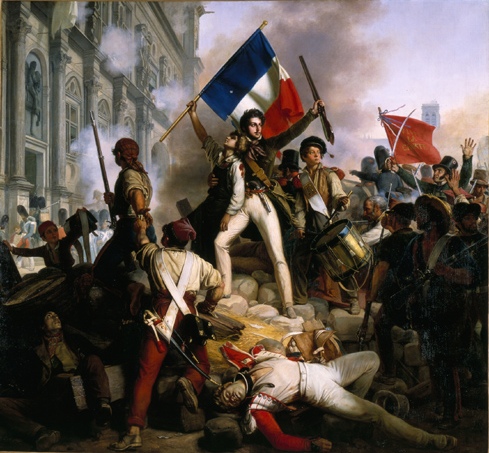
On the morning of July 14, 1789, a mass of about 80,000 Parisians in search of weapons, marched toward the Bastille, which was a royal arsenal filled with weaponry and ammunition. This was when the French Revolution began. The French Revolution was a major event in history. France was transformed from a monarchy with feudal privileges for the aristocratic and Catholic clergy, to a republic with equally free citizens, based on Enlightenment principles of life, liberty, and property. Its effects were widespread inside and outside of France. Of course this couldn't’t be done easily, Blood was spread, and heads were chopped off, not-to-mention, the effect of Napoleonic wars, but all for a good cause.

King Louis XV ruled and he was a great king and ruled under great control. But then he passed away, and Louis XVI took his place. He was a complete bad choice for the job. He ruled poorly, was very lazy, and also his wife, Marie Antoinette, splurged on an everyday basis. At that time, France ran under the Old Regime. French society was broken up into three estates. There was the First Estate, which consisted mainly of the Catholic Church and its clergy, the Second Estate was the nobility, who was the rich and aristocratic, and then there was the third Estate, while all the commoners and everyone else. The First Estate was excused from taxes, only having to pay a “voluntary” contribution every five years. They made up only one percent of the population. The Second estate also had tax exemptions, and while they held 30% of the land, they only made up of about 2% of the population. The Third Estate basically paid all the taxes. They made up more of the population than any other estate and yet they had no say in the government.

The first thing to actually “trigger” the French Revolution was the storming of the Bastille. After three hours of commoners fighting, the garrison of about 115 men gave up. The commoners in rage, beat marquis de Launay to death, cut of his head, and then carried him around the city with pride. When King Louis XVI heard of this, he asked, “Why, is this a revolt?” The duke who told him replied, “No sire, it is a revolution.” After that, the Reign of Terror began, which was when the French Revolution really got bloody with a stream of executions by the guillotine. This lasted about 10 months. During this time, it is said that about18, 500 to 40,000 people were executed.

At the end, a stream of women came pouring into Versailles, where King Louis XVI lived, carrying a varied assortment of house materials such as brooms, pitchforks, and etc, and took both King Louis XVI and his wife Marie Antoinette, away They were made prisoner. Both him and his wife were executed by the guillotine.

Tuesday, September 11, 2007

Copernicus and the trial of Galileo

The scientific revolution can be dated as having begun in 1543, coincidentally, the year in which Nicolaus Copernicus published his book De revolutionibus orbium coelestium (On the Revolutions of the Heavenly Spheres. Although many early cosmologies contemplated the motion of the earth around an inert sun, it wasn't until Copernicus's book that people actually started to support it. His book introduced heliocentrism in a whole new way. Copernicus's book presented a fully predictive mathematical model of a heliocentric system, which was later elaborated by Johannes Kepler and defended by Galileo Galilei, becoming the center of a major religious dispute.

Before the scientific revolution, the geocentric model of the universe was accepted by everyone. The geocentric theory is that the earth is the center of the universe and the sun and all the other planets went around it. This theory was adopted by both Aristotle and Ptolemy.

Galileo Galilei was known as the man to pioneer the "experimental scientific method" and was also the first to use a refracting telescope to make important astronomical discoveries. Galileo, by learning the merest description of the telescope, built a bigger and better model. Using his telescope, Galileo made significant discoveries about space, the planets and their moons. Galileo was a professor of astronomy in the University of Pisa, he was required to teach the theory of geocentrism. But later, in the University of Padua, he learnt of a new theory, Copernicus's theory. Galileo used his telescope and observed that that theory was the correct one. His support for this theory got him in trouble with the roman Catholic Church.

The Roman Catholic Church were very powerful during the 17th century and they still believe that the sun revolved around the earth. Galileo, spreading peoples awareness of heliocentrism aggravated them. The Roman Catholic church called him to Rome for trial. Inquisition convicted him of heresy and forced him to publicly withdraw his support to Copernicus's theory. He was also sentenced to life imprisonment, but due to his old age he was allowed to serve his time as house arrest in his villa in Arcetri. Galileo died at Arcetri in 1642. In 1992, the Roman Catholic Church admitted to having been wrong in dealing with Galileo.

Monday, September 10, 2007

Scientific Revolution: Scientific Method

Before the 1500's, scholars and academics would look toward the bible and ancient Greek and Rome for answers and ideas about science. The scientific revolution was when medieval scientific philosophy was abandoned for new methods of science. Scientists such as Bacon, Galileo, and Newton proposed a new ways to answer ideas. It was called the scientific method. The scientific method was a process of research where a problem is identified, data is collected, a hypothesis is made from the data, and than the hypothesis is tested repeatedly until a conclusion is made. This change was important because it allowed scientists to work with mathematicians and astronomers to get better, more reliable results.

The scientific method is made up of a few very simple steps. Firstly, you have to of course, create a question or problem you wish to be answered. Secondly, you do research on your topic so you can predict an answer for your question. Thirdly, you form an hypothesis, or an educated guess of what you think the answer to the question is. Remember that it doesn't matter if your hypothesis is wrong or right. After that, you have to conduct an experiment for your question. It would be best to repeatedly test your question for best results. Than, you have to collect all the data. Finally, you form an conclusion based on all you did.

An example of the scientific method can be when Galileo, a young Italian, proved Aristotle's theory wrong in the late 1500's. Aristotle's theory was that heavier objects fell faster than light objects. Galileo tested the theory by going up to the famous Leaning tower of Pisa and he dropped some stones of different sizes and weights. His experiment proved Aristotle wrong and lead us to what we know now, objects of different weights will fall at the same speed.

Thursday, September 6, 2007

Evolution vs. Creation

Evolution vs. creation. Also, popularly known as the reason vs. religion battle that has been going on for ages. There has been evidence to support both but no proof. People just believe what they choose to believe in.

Evolution is the theory that all organism's have an common ancestor. Darwin's theory was that random mutations would occur within a organism's genetic code, which is called crossing over. The advantageous mutations would be kept because they aid in survival. Then these organisms that are best adapted in their environment reproduce and pass on their traits to the nest generation. The less adapted organisms will eventually die. This process is known as survival of the fittest. Due to these mutations and competition, organisms with mutations would move to a new environment and learn to adapt there, making changes in its appearance. Then speciation will occur. Speciation is the splitting of one species into two due to separation by reproduction by some effect of a different trait. Then eventually, the organism will move again and so on and so forth.

Creationism is the believe that the earth, all the creatures in it, and the universe were created by god, or such a deity. Most creationists believe that the earth was created in seven days and was shaped by floods as stated in the book of Genesis, for Christians and Jews, and the Qur'an, for Muslims. The theory of creation says that creatures started out lucind and seperated creatures. But creationist do not believe that those creatures gradually change into completely different and seperated creatures during evolution. They do not believe that through time, single-celled organisms evolved into more complex plants and animals and eventually into Homo Sapiens. Creation is the belief that ever organism is created by someone whose existence is yet unknown to us. There are many different types of creationism. There is young earth creationism, old earth creationism, gap creationism, progressive creationism, intellignet design, and thiestic creationism.